


01What it sells and who buys it
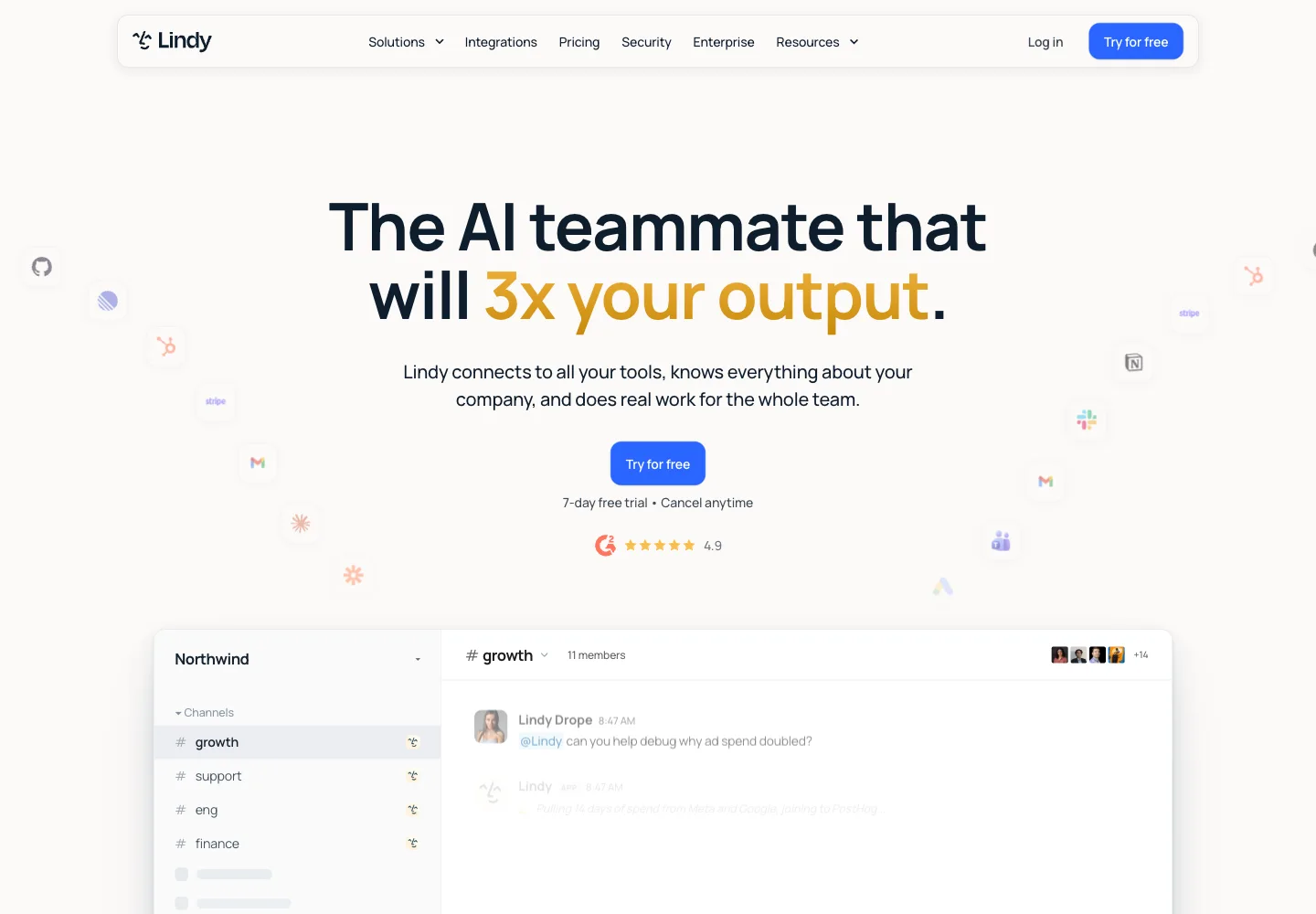
The company pivoted from Teamflow's virtual office to Lindy, an AI assistant for email, meetings, scheduling and connected business tools. The current offering also works as a shared teammate inside Slack.
02How the business makes money
Current self-service plans charge $29.99, $99.99 or $199.99 per user per month, with work credits pooled across the team. Revenue scales with seats and workload, while enterprise contracts add security and onboarding support.
03Marketing and customer acquisition
When virtual-office demand faded, Lindy moved from recording conversations to carrying out the work those conversations created.
- 01
The original market was virtual work
SourceTeamflow sold a virtual office for remote teams. Pandemic-era demand helped it raise a $35 million Series B led by Coatue in 2021 at a $225 million valuation. That historical financing is the valuation shown in the directory.
- 02
Meeting summaries exposed a more valuable job
SourceAs demand weakened, meeting summaries revealed a second job: updating Salesforce after calls. Tool execution became the basis for a full pivot to AI agents in January 2023.
- 03
Positioning caught up with the product
SourceThe broad idea of an AI employee became a workflow product for early adopters. The founder describes five major product changes. A concrete automation workflow gave prospective buyers a clearer evaluation than a broad promise of an AI colleague.
- 04
Repeated launches became a distribution channel
SourceSearch and demonstration videos on X supplied recurring discovery. Two or three major launches a year reportedly brought 10,000–50,000 sign-ups each. Monthly recurring revenue exceeded $100,000 by February 2025; ongoing revenue depended on converting that attention into repeated paid work.
How the growth mechanism works
- Demonstrate a recurring task
- Connect the user’s tools
- Pay as work expands
- Extend to the next workflow
Lindy’s entry point was an early adopter with recurring operational work. Demonstrations distributed to an existing founder audience made the delegated task concrete, while search continued capturing demand between launches. Usage billing then connected repeated work to revenue.
This was a capital-supported pivot. Teamflow’s financing and engineering team provided time for product redesigns. The transferable mechanism is not simply posting launch videos: it is identifying a repeatable job, making execution dependable, and showing that job to a relevant audience.
04Funding and expansion
Teamflow raised a $35 million Series B led by Coatue in 2021 at a $225 million valuation. The subsequent Lindy pivot followed that financing and operating history. The table's valuation refers to Teamflow at that round.